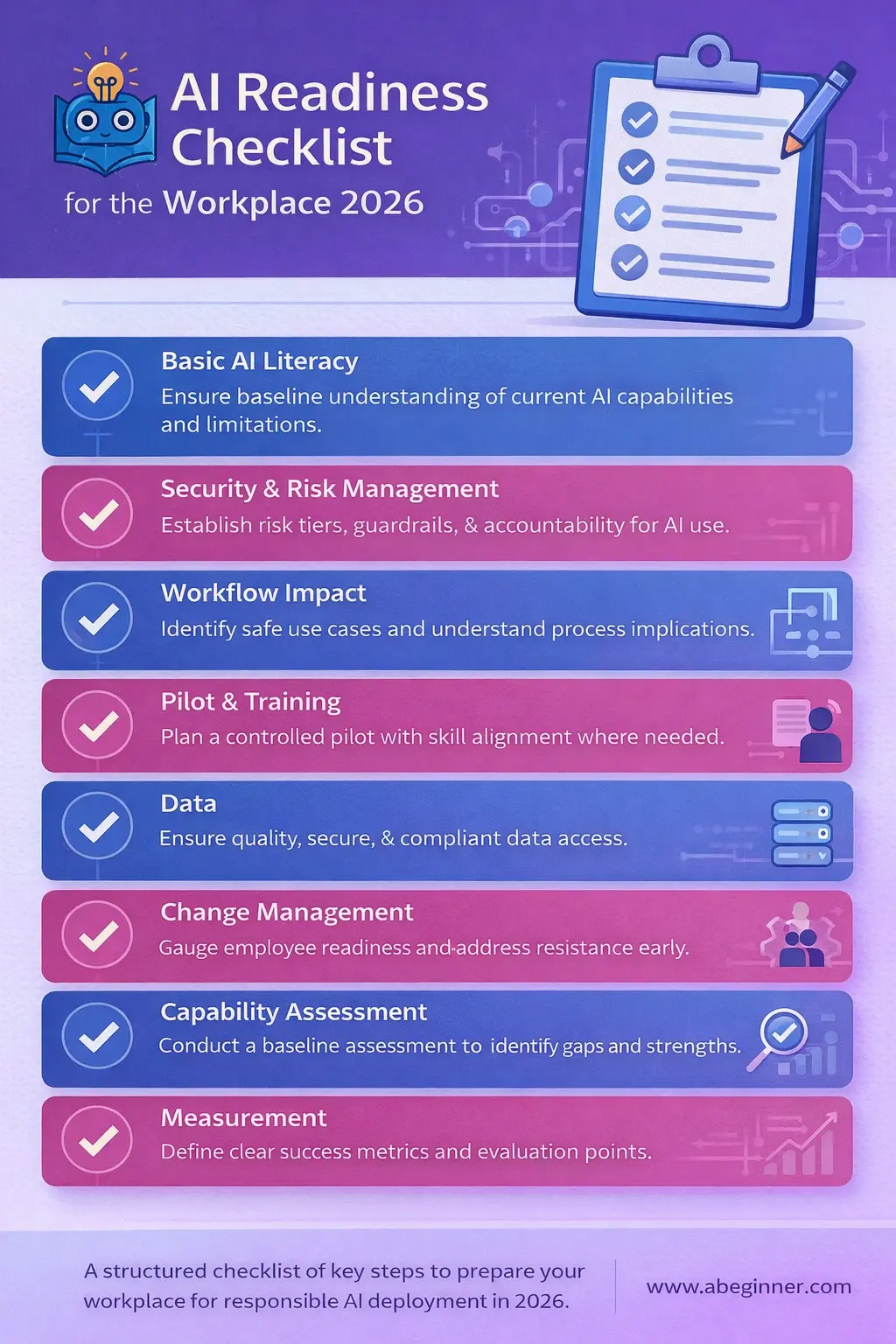
Use this AI readiness checklist to assess whether your organization is prepared to introduce AI responsibly. The strongest programs usually have five things in place: leadership alignment, practical guardrails, workforce capability, workflow fit, and a way to measure results.
AI is already showing up in many workplaces — often before organizations are fully prepared to manage it. The bigger question is whether it is being introduced in a way that is structured, safe, and useful.
That is where an AI readiness checklist becomes valuable. It gives leaders and internal champions a practical way to evaluate whether the organization is actually ready to move from scattered experimentation to responsible adoption.
This guide is designed for managers, directors, operations leads, and other professionals responsible for introducing AI inside real organizations. It is written for the workplace — not for hobbyists, not for tool collectors, and not for people chasing hype.
Why this matters now: enterprise AI use is expanding, but scaling useful, governed adoption is still a challenge for many organizations. That gap between activity and capability is exactly why readiness matters. See the sources at the end for current research from McKinsey, Microsoft, and Deloitte.
In this guide
AI readiness in 60 seconds
AI readiness is how prepared your organization is to adopt AI safely, consistently, and in ways that support real business outcomes.
In simple terms, it means you are asking questions like:
- Do we know where AI can actually help?
- Do we have clear boundaries for safe and acceptable use?
- Do our people understand how to use AI responsibly?
- Do we have ownership, oversight, and a realistic rollout path?
- Can we tell whether AI is improving work or just creating activity?
Short version: access to tools is not the same as readiness. Readiness is organizational capability, not just enthusiasm.
AI Readiness Checklist for the Workplace (2026)
Use the checklist below as a practical review. You do not need every item fully solved before starting, but the more “yes” answers you have, the stronger your foundation usually is.
1. Leadership alignment
- Is there clear ownership for AI efforts or rollout decisions?
- Is leadership aligned on why AI is being introduced?
- Are expectations defined for what success should look like?
- Is AI being introduced intentionally rather than reactively?
2. Governance and guardrails
- Is acceptable use clearly defined for employees?
- Are there boundaries around sensitive data, client data, or regulated information?
- Are risk tiers or usage categories understood?
- Do people know where AI use should be limited or reviewed more carefully?
3. Workforce capability
- Do employees understand basic AI strengths and limitations?
- Are people being supported with practical guidance instead of assumptions?
- Are skills aligned to the real workflows where AI will be used?
- Is confidence improving with structured use?
4. Workflow integration
- Have you identified a few real workflows where AI could help?
- Are those workflows low-risk enough to pilot safely?
- Is AI being applied to repeatable work rather than random one-off experiments?
- Are use cases defined clearly enough to test and compare?
5. Measurement and outcomes
- Is there a way to measure time savings, quality, consistency, or impact?
- Can you compare before-and-after results?
- Is someone responsible for reviewing whether the pilot is useful?
- Are you looking for business value instead of just activity?
Need a fast baseline? Work through the checklist above, then use the scoring guide below to turn your answers into a structured first snapshot before going deeper.
How to score your readiness
If you want to make this checklist more practical, score each item as one of the following:
- Yes — mostly in place
- Partly — some progress, but inconsistent
- No — not yet in place
Then review the pattern:
- Mostly Yes: you may be ready for a controlled pilot or a more structured rollout path.
- Mostly Partly: you likely have momentum, but need clearer guardrails, ownership, or workflow selection.
- Mostly No: that is not failure. It usually means this is the right time to slow down and establish clarity before scaling.
Important: the goal is not to “pass” the checklist. The goal is to identify where structure is missing before AI use becomes harder to govern.
Signs your organization may not be ready yet
Many organizations are still early. That is normal. A few common signs of low readiness include:
- Employees are experimenting with AI, but there is no shared guidance.
- Leadership wants movement, but use cases are still vague.
- No one clearly owns AI rollout, coordination, or policy decisions.
- People are talking about tools more than workflows, outcomes, or risk.
- There is enthusiasm, but not much structure behind it.
That does not mean you should stop. It usually means you should slow down enough to build a better foundation.
Low readiness
Scattered experiments, unclear ownership, weak policies, and little measurement.
Moderate readiness
Some alignment and useful pilots, but inconsistent guardrails or uneven capability.
Higher readiness
Defined ownership, controlled pilots, practical guardrails, and measurable outcomes.
What should an organization do after the checklist?
If this checklist feels relevant, the next move is usually not to chase more tools. It is to build clarity.
- Assess where your organization stands today.
- Define basic guardrails and acceptable-use boundaries.
- Identify one low-risk workflow for a controlled pilot.
- Assign ownership and decide how results will be measured.
- Scale only after the early work proves useful and stable.
If you want the plain-English background, read What Is AI Readiness? If you want to build the skills to act on your results, that is where the Complete AI Learning Path fits.
Where this fits
This checklist is part of a larger AI readiness cluster built for professionals and structured organizations.
- Score your readiness with this checklist if you want a quick baseline.
- Explore the Complete AI Learning Path if you want structured, practical AI skills.
- See AI Training for Business if you want to get a team through the basics together.
Sources and research
This checklist is based on the practical patterns showing up across current workplace AI research, especially the gap between AI usage and enterprise-level readiness, governance, and scale.
- McKinsey, The state of AI: How organizations are rewiring to capture value (2025)
- Microsoft, 2025 Work Trend Index and related WorkLab reporting (2025)
- Deloitte, State of Generative AI in the Enterprise (2025) and State of AI in the Enterprise (2026)
Frequently asked questions
What is an AI readiness checklist?
An AI readiness checklist is a practical way to review whether an organization has the leadership alignment, guardrails, workforce capability, workflow fit, and measurement needed to adopt AI responsibly.
Why does AI readiness matter before rolling out AI tools at work?
Because organizations that roll out tools without ownership, policy, training, or clear use cases often create inconsistent results, unnecessary risk, and weak adoption.
What should be included in a workplace AI readiness checklist?
A workplace AI readiness checklist should review leadership alignment, governance and guardrails, workforce capability, workflow integration, ownership, and measurement.
How do you know if your organization is ready for AI?
An organization is more likely to be ready for AI when it has defined ownership, safe-use guidance, realistic pilot opportunities, workforce support, and a way to measure outcomes.
What should happen after completing an AI readiness checklist?
After completing an AI readiness checklist, the next step is to define guardrails, identify one controlled pilot, assign ownership, measure results, and scale carefully.
Looking for the practical first step? Score your readiness using the checklist above. Ready to build the skills behind it? The Complete AI Learning Path is the next step.